Wednesday, 17 November 2010

Script

For my last show and listen I typed out an internal conversation with some characters I'd been playing about with for a while; a puppet boy, a skeleton and a cosmonaut. I fleshed it out a bit and I got this:


DESERT/ EXT – DUSK
Cosmonaut is stranded next to the remains of her spacecraft. 
S is a skeleton that has just come across the cosmonaut. SEAGUL is a (possibly) 
life-size puppet in the form of a young boy. VOSTOK is the lost cosmonaut, who gets more and more distraught as the conversation continues. Eventually her helmet fills up with tears, getting in the way of her speech. 
S starts by inspecting the spacecraft before engaging the apathetic cosmonaut.


S
Space! How’d it feel? You’re a pioneer

VOSTOK
The Earth is blue, how wonderful.

SEAGUL
A pioneer for what? For ridiculous endeavours? There is nothing up there. There’s not even a God to meet.

S
But, but it’s Space – the final frontier. It’s the imagination. It’s possibility, science!

VOSTOK
I want to go back, earth is not enough now. I have seen how fragile it is.

SEAGUL
You’re the fragile one. The only reality is here now

VOSTOK
(Silently crying)

S
Yes, but one day we can make fantasies a reality.

SEAGUL
For what point or purpose?

S
For a utopia, a….a better life for all!

SEAGUL
A better life for all you say? The very action of ‘striving’ for a better future creates a ‘utopia’ of sorts. It allows a chance for change within a mind. However ‘life’ is not changed, life would not necessarily be better.

S
You are too closed minded. If everyone worked together to create a better system, a happier society, a fairer world then…then…

SEAGUL
Then what? That sort of system only takes advantage of the dead. The only way to truly achieve equality or fairness would be to eradicate death, and bring back everyone who’d ever lived. Then, everyone who worked towards a ‘better society’ could experience it.

VOSTOK
The Motherland! My Motherland! I miss the faces of my parents.

S
But, but that’s impossible

SEAGUL
Uh, uh uh uh! Nothing’s impossible remember, ‘science’! If your beloved science can take a man-

VOSTOK
(Quietly weeping)

SEAGUL
-or woman, into space, into the cosmos, then what’s to stop it from bringing back the dead? All we need to attain immortality is the right technology.

S
You’re confusing science and the spirit.

SEAGUL
No perhaps it is you who is confused. Who’s to say that science and the spirit are separate; that they belong on different planes?

S
Are you saying that the only way it’s right, or fair, to try and better our existence, is if we simultaneously work on removing the only certainty in life? If you think like that you may as well end it all now

VOSTOK
Without my spacecraft I am already dead.

SEAGUL
Why should I? I’m perfectly content with my life now. Just because I believe space travel is pointless.

S
You only think it’s pointless because you are selfish and small. You lack imagination.

SEAGUL
I see no problem with having little imagination, and it all depends on your morals whether I’m seen as selfish.
Besides all this talk of immortality is rich coming from you, no?

VOSTOK
(Tears have been filling her helmet and have just reached her mouth)
How is this [inaudible] monument[?] [inaudible] Blessed heroes.

S
I will reach my end just as you and all others.

SEAGUL
Humph, how poetic.


S
“The struggle
itself toward the heights is enough to fill a man's heart.”

SEAGUL
That’s absurd

S
Yes, but it’s also happiness

VOSTOK
(Craning her head to reach the air bubble in her helmet)
Oh, how I want to be happy again!

SEAGUL
(Kicks cosmonaut)
Get out of that bloody suit!
[To S]
Who’s ‘Happiness’ what did they do?

VOSTOK
I used to be – [tears finally fill up helmet]

S
(Looking with concern at flailing cosmonaut)
…Happiness is an emotion; the quote is Camus - is she going to be alright?

SEAGUL
(Dismissively)
She’ll be fine.

Tears forcibly break the helmet and the cosmonaut is flushed out.

SEAGUL
There, see? Fine.

I'm going to turn it into a comic and see what happens.

Tuesday, 9 November 2010

Critical Review

Handed in on the 1st Nov 2010. I wrote it in the style of a film script. The piece of work I reviewed was Stuart Croft's Drive In:


Critical Review


Stuart Croft – Drive In


Ruby Lloyd-Burman


INT. TETHER ART GALLERY – DAY

ART PUNTER 1 is stood outside Stuart Croft’s Drive In idly flicking through the exhibition publication. ART PUNTER 2 approaches AP1.

AP2
(Pointing)
What’s in here?

AP1
(Bored tone)
A Slick, well-lit film. Running time: infinity or until you turn the fucking thing off.

AP2
(Questioning look)

AP1
(Bored tone)
Whole thing takes place within a car. It’s raining outside. The man drives. The woman is telling a story, full of slang, conversational language, archetypes and mystic imagery.
A large section of the story follows a typical romance story, only the setting is unusual – castaways on desert islands. Boy meets girl. Guy’s a stiff; girl’s a mystical, beautiful, resourceful, sexy artist.

AP1 pauses for breath

AP1
(Bored tone)
He decides to write a semiautobiographical story in blood. She reads it and gives honest and not very positive feedback. He goes off in a huff ‘to get some space, or some shit like that’ and has an affair gets an STD; the relationship breaks apart he leaves, starts to miss her then the story repeats as he is again washed ashore an island and meets a mystical, beautiful, resourceful, sexy artist.
Male actor is passive but attentive to his passenger’s story.

AP2
(Hastily)
Whoa, whoa! Don’t tell me every detail.

AP2 goes into the curtained space. AP1 is left to read the publication again. AP2 returns after 10 minutes
AP2
It’s very dark in there.
I bumped into a chair.

AP1 looks up from the publication at AP2

AP2
I found the darkness distracting, until the story she tells sucked me in. Then, I dunno, the darkness sort of became like a, a metaphor…

AP1
(Non-committal noise)

AP2
Do you think the woman in the story is the same as the woman in the car?

AP1
(Cocks head pensively)

AP2
(Continuing)
Is the driver the same as the man in the story?

AP1
(Matter-of-factly)
I think the relationship between the characters in film and the characters in the story is ambiguous. As is the relationship between the male and female character.

AP2
But she talks like it’s happened to her, like she’s recalling something very real (despite the fantastical nature of the story).
How it’s shot echoes that too – pauses where the camera lingers on her face, or her hands.


AP1
(Nodding in agreement)
She tells the story emphatically, which throws you off. Her emotional involvement makes you think the story could be about the current relationship in the car, a past relationship of the storytellers, or an account of something that happened to someone once.
Hell, it could even be an analogy for every modern relationship.


AP2
(Considered)
It might not even be about ‘relationships’ at all

AP1
(Defensive)
Well, yeah, obviously.

There is an uncomfortable pause. AP2 re-enters the exhibition space. AP1 hesitates for a couple of minutes then joins AP2. They both reappear 10 minutes later.

AP2
(Slowly)
I really like it. It’s…it feels like you know when you look in a mirror reflecting another mirror.
You can see yourself reflected into infinity.

The cut is seamless – it’s difficult to tell where the film begins and where it ends.

AP1
I don’t think there is an ending, or a beginning. The characters are trapped, like your reflection is trapped in the two mirrors.

AP2
(Sound of agreement)
…so is it repetition that leads to entrapment?


 AP1
I’m not sure it could even be called repetition. Repetition suggests an action and time. It also suggests a mastery of something, a resolve, an ending.
But this film seems timeless – there’s no future. It’s not like she repeats the story, ‘cause then it’d vary slightly; different intonation here, different word there. It’s just, the same.

AP1 pauses in thought, AP2 shuffles awkwardly.

AP1
There’s no retelling of the story in Drive In, there is no revision, no history, no future. We are all stuck.

AP2
(As if remembering something once known)
“The narrative seems to have broken free of the human psyche and manifested itself”[i]

AP1
(Enthusiastically)
 There is, unequivocally, no resolve. And it’s about … its inherent condition of circularity, of irresolution if that’s the correct word, in order to manifest entrapment and denial and recurrence.” [ii]

AP2
There’s no way out for the characters. And no way out for the audience – you’re never given the next scene.

AP1
Croft is messing with expectations of cinema, of Hollywood – why else would he make the film look so slick and sexy? It could be lifted from a big budget film. It’s called Drive In, if that doesn’t scream American cinema, I don’t know what does. Drive. In.


AP2
People in their cars, in their own atmospheres going in. Bubbles within bubbles. Reflection within reflections.

AP1
It’s insular – the characters stay within the car for the whole film, protected from the elements. Just like when you watch a film, you can choose to not get emotionally involved. The silver screen protects you; you’re given the luxury to just observe, but observe intimate things without having to take responsibility.

AP2
It’s like, he’s taken Hollywood’s language and told an anti story, with an anti plot.

AP1
I don’t know if I’d go that far…maybe. I’m not sure. All I know is, the narrative is never resolved it never develops. It just stays painfully the same.

AP2
I guess it then comes down to the viewer – you decide when it ends.

AP1
Yeah but characters can’t.
You’re lucky.

AP1 replaces the exhibition publication, nods at AP2 and leaves. AP2 picks up and idly flicks through publication. AP3 arrives, looks around with an air of uncertainty. AP3 stops at the entrance of exhibition space and looks to AP2.

AP3
(Pointing)
What’s in here?


[i] Quote from What Happens Next, Gabriel Coxhead, publication to accompany exhibition
[ii] Quote from interview with the Stuart Croft. Available at: http://www.apengine.org/2009/11/stuart-croft/ [accessed on 24th October 2010]

cake

Birthday cake from the 24th oct :

Also painted the X-men symbol onto my hand.
I am one of the Xavier Institute's special students


Wednesday, 20 October 2010

Youth's Dead Private View


Icarus V.2.0, Ruby Lloyd - Burman
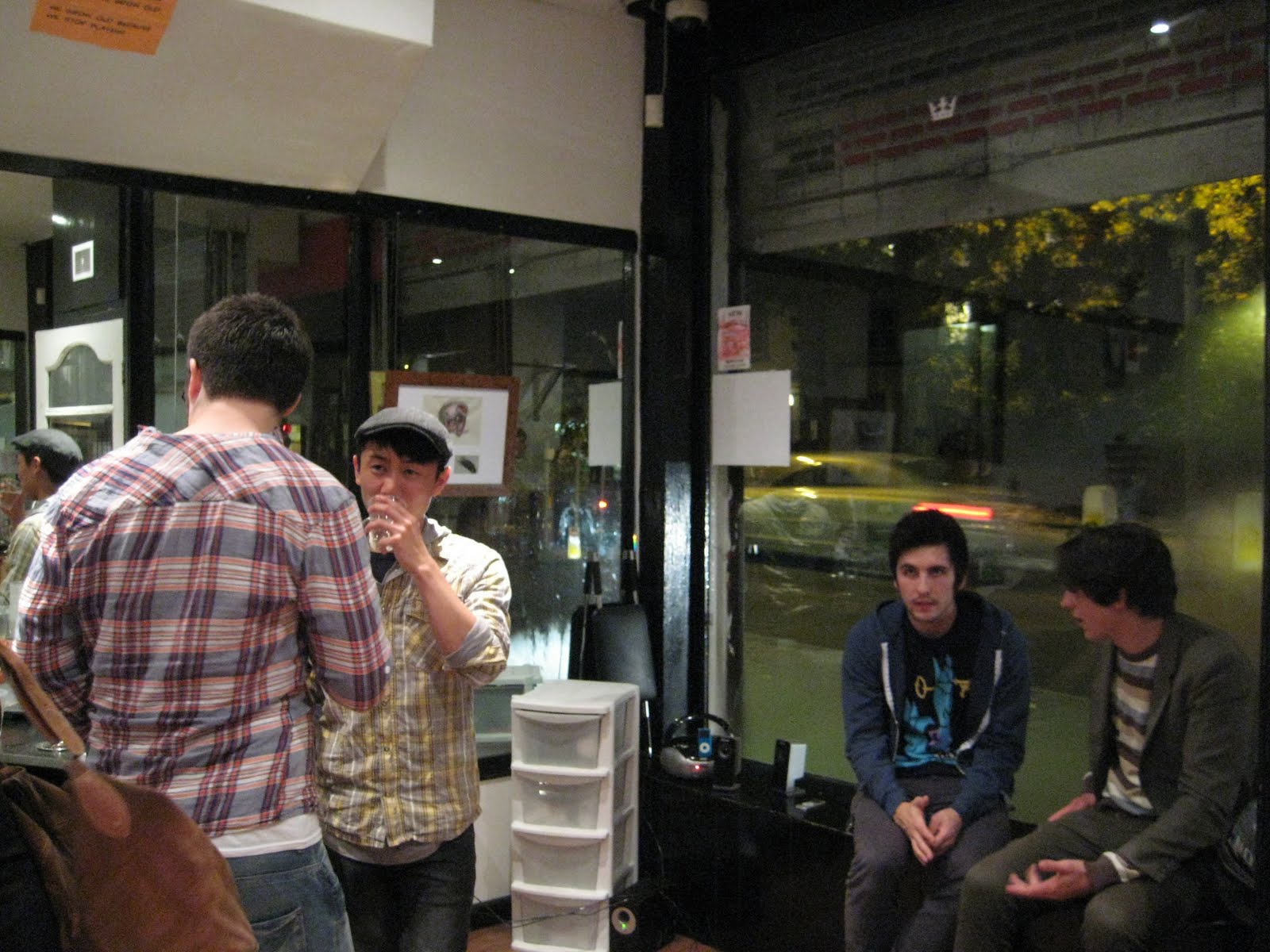
Private view of the exhibition Youth's Dead. The exhibition is in a small hairdressers on Mansfield Road. All work was conceived and made in less than a week.
First one's mine.
Silicone, Emily Johnson
Live Change Die, Bobby Sayers
The Chav in the Iron Mask, Joe Cerski
Chromadepth Experiment II, Darren Ralphs

Tuesday, 19 October 2010

ICARUS V.2.0


Mixed media image I did for an exhibition organised by a couple of my peers. The exhibition title is Youth's Dead and the title of this piece is Icarus V.2.0.

Approx 42cm x 30cm

Private view is tomorrow (Wed 20th)


-->Within the context of my work space.


Statement of Intent L2

Handed in on 18th Oct 2010

Last academic year I did a lot of work around the theme of failure. I worked with trying to represent time and spent energy through process. Through the course of this work I hit a point where I could no longer progress with the idea in the same format. It had stopped being meaningful. Basically, despite the physical discomfort[1] the work became easy to make and I stopped playing. I had become trapped by the system I had created – which I think is a risk when dealing with failure as a subject.

However, I am still interested in the same themes as last year: failure, the intangible, the ineffable, absurdity, the unresolvable, the inescapable, ambiguity and repetition.[2] I want to explore the tension between thought and action[3] by playing with the language and symbols of myth, fairy tales, Science Fiction and Fantastical Realism.

This year I want to explore these areas using narrative. Towards the end of 1st year I was starting to look at how I could incorporate graphic novels into my work, as they have been a long time love of mine. I realise I have always kept comics separate from my fine art practice and often kept text and image separate too. So I was working with image, text and speech bubbles, until I came across some old projector slides. The blank slides became my panels (frames) and my interest became filling these frames while the text component became pushed to one side. So yet again these components were kept separate.

I’d like to incorporate text in my work this year; Tim Etchells is a fantastic artist to look at for this, I adore his writing. He is funny, poignant and at times disturbing. City Changes was an Etchells piece I saw over the summer at the Gasworks in London. It consists of 20 A4 sheets of paper, framed behind glass. The first one describes a city that never changes and the inevitable stagnant nature of the place. This first piece of text is rewritten 19 times “to produce a sequence of increasingly preposterous variations, mutations and exaggerations of this imaginary place.[4] I found the experience of reading these works very intense. They fluctuate between humorous and chilling, and elements remind you of very real places.

I’d like to try making my own comic that deals with some of the themes I’m interested in, which would make it seem neither of the graphic novel world or of the fine art world. There are two characters that have been following me for some time, a skeleton and a puppet child; I need to do something with them. A comic seems like a positive way to give them some life and ground them in a reality.

I am also interested in film and animation. Over the summer I made an animation for a short film, which made me realise the potential of animation as a medium. I definitely want to do more this year.

I recently read Narcissus and Goldmund by Herman Hesse, and despite the fact that Hesse writing style can be a little cold, I loved how he tried to describe the constant struggle to unify the heart and soul with the mind (which is the artist’s job, according to Hesse). There is a beauty in this struggle. I cannot articulate it properly yet, but this book had a big impact on me, possibly because of how it highlighted my own struggles with unifying my disparate elements.


[1] I was hand drawing hundreds of thousand of tiny squares

[2] I do realise that I have very possibly listed a human experience of life and death.

[3] Which is the space of possibilities; the liminal space.

[4] Quote taken from Tim Etchells website: http://www.timetchells.com/projects/works/city-changes/